BIM Complete Publication Set · 2026

When the unexpected happens or something goes wrong, someone has to provide answers, and fast. Do you have a plan?

Every serious incident ends the same way: someone in a conference room asking, "who owned this, and what do we do?"

The people who survive that conversation aren't the smartest ones in the room. They're the ones who walked in already knowing their part — before anything went wrong.

Most of them have never been told exactly what they own. BIM fixes that.

Four coordinated publications · One organizational framework · Instant PDF download

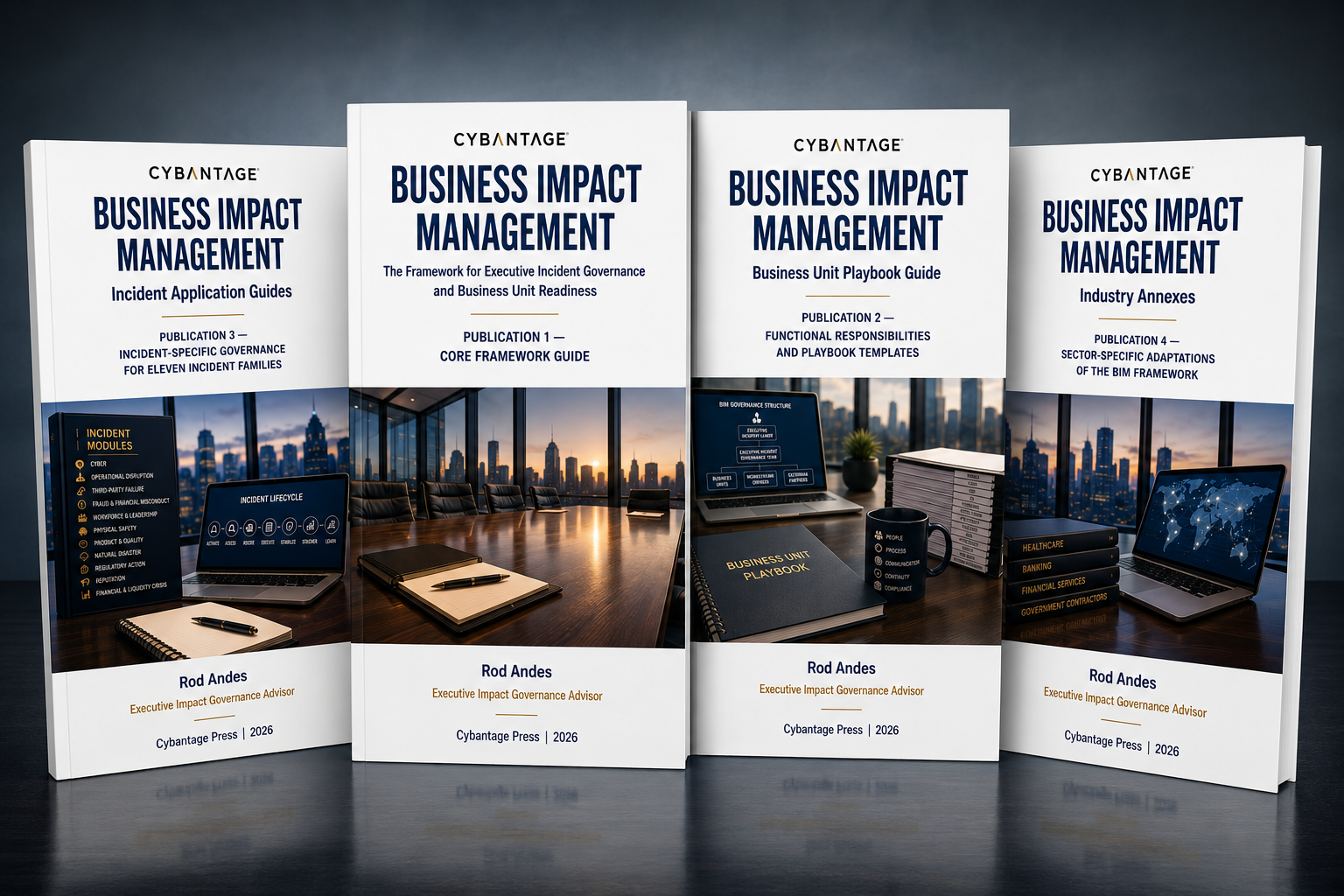
The four Business Impact Management publications displayed together

What Business Impact Management Is

Business Impact Management is not crisis management.

It doesn’t tell an organization what decisions to make. It doesn’t provide predetermined answers or direct leaders through a crisis.

It helps the organization identify the questions, decisions, and pressures that are likely to arise when a serious incident affects the business.

The problem nobody warns you about

The people who get blamed aren't the ones who caused it. They're the ones who couldn't show what they did.

Your company has a plan for the response team. Great. That plan protects them. It does not protect you — the manager, the HR lead, the finance analyst, the admin who suddenly has to make a call at 9 p.m. on a Tuesday.

When it spreads — and it always spreads — you're the one fielding questions about payroll, contracts, customers, communications, staffing, and legal exposure. Nobody defined who owned that. Now it's yours.

And after the dust settles, someone writes a report about what went wrong. That report has names in it. The names of people who didn't have an answer when they should have.

BIM makes sure yours isn't one of them.

Where the questions land when things go wrong
  • People
  • Operations
  • Finance
  • Legal
  • Insurance
  • Customers
  • Communications
  • Contracts
  • Regulators
  • Board Oversight
  • Leadership Accountability
  • Long-Term Recovery
The gap is real. The set is ready.Four publications. One clear structure. Delivered instantly.
BIM is not crisis management

Crisis management shows up after the damage. BIM is what you build before.

Crisis management is a response mode — press releases, talking points, damage control. Business Impact Management is the governance underneath: who decides, who owns it, and what every business unit is expected to have done before anyone calls it a crisis.

Crisis Management

Reacts to the moment

  • Activates after impact is public
  • Focused on comms and reputation
  • Owned by comms or the executive team
  • Reactive — one incident at a time
  • Ends when the news cycle ends
  • Answers "what do we say?"
Business Impact Management

Governs before, during, and after

  • Prepares governance before impact reaches leadership
  • Focused on decisions, ownership, and accountability
  • Distributed across every business unit that could originate an event
  • Structural — a repeatable framework for any incident type
  • Continues through legal, HR, finance, insurance, and long-term recovery
  • Answers "who decides, who owns it, what do we need to do?"

If crisis management is the fire truck, BIM is the building code.

You still want the fire truck. You just don't want to be the reason it was called.

When does a problem become a leadership event?

Not every operational problem is a BIM event. But some are — and the difference matters.

One of the things BIM establishes is a clear escalation model. It tells you when an issue is yours to handle, when it needs coordination, and when it becomes an executive-level event requiring formal governance. Most people don't know where they sit on this model until they're already in it.

Level 1

Departmental Issue

The problem stays within one function's authority and normal procedures. You handle it internally. No BIM activation required.

Level 2

Cross-Functional Incident

Multiple departments need to coordinate. Your normal leadership structure still applies — but people need to be aligned and decisions documented.

Level 3

BIM Activates — Enterprise Business-Impacting Incident

The event creates significant operational, financial, legal, regulatory, or reputational consequences. Formal executive incident governance kicks in. This is when BIM matters most.

Level 4

Enterprise Crisis

The event threatens the organization's ability to operate, meet obligations, maintain stakeholder confidence, or defend leadership decisions. Every executive function is engaged.

BIM activates when a local issue crosses one or more of these thresholds:

  • Threat to life, health, or safety
  • Material operational disruption
  • Significant revenue or cash-flow impact
  • Regulatory reporting obligation triggered
  • Legal or contractual exposure
  • Customer, patient, or public harm
  • Insurance notice or consent required
  • Board reporting requirement
  • Significant reputational exposure
  • Loss of a critical supplier, system, facility, or workforce
  • Executive misconduct or leadership incapacity
  • Cannot be managed within one department's authority
What BIM does for you

A structure that protects you when everything goes sideways.

1

Tells you exactly what you own — before it hits

No more guessing whose call it is at 2 a.m. You know what you decide, what you escalate, and what isn't yours to carry.

2

Puts your name next to the right decisions

Shows what HR, Finance, Legal, Ops, Comms, IT, and everyone else owns — so when the questions start, the answers are already sorted.

3

Tells you when to raise your hand

Clear activation and escalation triggers. You stop hoping someone else notices, and you stop being the one who should have.

4

Keeps you out of the crossfire

One structure for cross-functional calls. No more turf fights, no more decisions falling into the gap between departments — the gap you get blamed for.

5

Builds your paper trail as you go

Documents what you knew, when you knew it, and what you did. When leadership, legal, or regulators come asking, you have a record — not a memory.

6

Protects you after the smoke clears

The review is often worse than the incident. BIM carries you through recovery, corrective action, and the accountability review that decides careers.

BIM is not a cyber framework

An incident can begin anywhere in the business — and every one of them ends up in leadership's lap.

Cyber gets the headlines. It's not the pattern. A payroll error, a supplier collapse, a workplace incident, a regulator's letter, a bad product batch, a founder in the news — every one of them starts in a department, then spreads until executives, HR, finance, legal, comms, and the board all have to make decisions together. That's the moment BIM was built for.

Where incidents actually start

Every one of these is a real business unit where a serious event has originated — and forced enterprise-level decisions.

  • Executive LeadershipExecutive misconduct, succession event, governance failure
  • FinanceLiquidity crisis, fraud, wire fraud, payroll failure
  • Human ResourcesWorkplace violence, labor action, mass resignation
  • Information TechnologySystem outage, cloud failure, data loss
  • Information SecurityCyberattack, ransomware, data breach, insider threat
  • OperationsFacility shutdown, equipment failure, business interruption
  • Legal & ComplianceLitigation, regulatory investigation, license issue
  • CommunicationsReputational event, social media crisis
  • Sales & CustomerMajor customer loss, service disruption, breach of contract
  • Procurement & SupplyCritical supplier failure, logistics disruption
  • Manufacturing / QualityProduct defect, recall, contamination, plant shutdown
  • Risk & InsuranceCoverage dispute, claim denial, uninsured loss
Who has to decide when it spreads

Almost every organization runs on the same executive functions. BIM lines up decisions with the people actually accountable for them.

  • Executive Governance
    CEO / Board
  • Finance
    CFO
  • Legal & Compliance
    General Counsel
  • Human Resources
    CHRO
  • Information Technology
    CIO
  • Information Security
    CISO
  • Operations
    COO
  • Communications
    Comms / Marketing
  • Customer & Revenue
    CRO / Sales
  • Procurement & Vendors
    Procurement / COO
  • Enterprise Risk & Insurance
    Risk / CFO
  • Business Continuity & Recovery
    COO / Resilience

BIM is not organized around incident types. It's organized around a simpler question: when an event creates consequences that cross department lines, who decides — and are they ready?

Working in a specialized industry function? See how BIM lands in your world in the By Industry section below.
Your department is on that list.BIM tells you what to do when it happens.
Find your business unit

Pick where you sit. See what happens when an incident starts on your desk.

Every serious incident starts somewhere. Choose a business unit to see a realistic scenario, who gets pulled in, and where BIM covers it.

If it starts here

A senior manager is accused of harassment. Within hours it's on social media, legal is on the phone, and the CEO wants a decision by noon.

Who gets pulled in
  • CHRO
  • General Counsel
  • Communications
  • CEO
Where BIM covers it

Publication 2 · HR Playbook and Publication 3 · Incident Application Guides

By industry

The same framework. Your industry's realities.

BIM's governance is universal. Publication 4 translates it into the specialized functions and incident patterns of each industry — so the framework fits how your world actually works.

Healthcare

When care can't wait for a meeting.

Where it starts
  • Clinical Operations
  • Patient Safety
  • Pharmacy
  • Revenue Cycle
What it looks like

A medication error affects three patients before end of shift. A family calls the local news before leadership even hears the name.

Who gets pulled in
  • Clinical Ops
  • Patient Safety
  • Legal
  • Comms
  • CEO
Publication 4 · Healthcare Annex
Financial Services

When trust is the product.

Where it starts
  • Lending
  • Payments
  • AML / Fraud
  • Treasury
What it looks like

A payments outage blocks corporate transactions on quarter-end. Regulators want a report before markets open.

Who gets pulled in
  • CIO
  • CISO
  • Compliance
  • CFO
  • Comms
Publication 4 · Financial Services Annex
Manufacturing

When one shift can turn into a recall.

Where it starts
  • Plant Operations
  • Product Quality
  • EHS
  • Industrial Control Systems
What it looks like

A quality deviation is found in shipped product. Legal advises hold. Sales says customers won't wait. The line is still running.

Who gets pulled in
  • COO
  • Quality
  • Legal
  • Comms
  • Customer
Publication 4 · Manufacturing Annex
SaaS / Technology

When your uptime is someone else's business.

Where it starts
  • DevOps
  • Site Reliability
  • Trust & Safety
  • Customer Success
What it looks like

A partial data exposure hits enterprise customers. Contracts require notification in 24 hours. Support is drowning.

Who gets pulled in
  • CISO
  • CIO
  • Legal
  • CS
  • Comms
Publication 4 · SaaS Annex
Utilities

When the lights stay off and every phone rings.

Where it starts
  • Generation
  • Grid Operations
  • Field Services
  • Outage Management
What it looks like

A regional outage passes the four-hour mark. Regulators, media, hospitals, and the public each need a different answer.

Who gets pulled in
  • COO
  • Ops
  • Regulatory
  • Comms
  • CEO
Publication 4 · Utilities Annex
Government / Education

When the community expects you to already know.

Where it starts
  • Public Safety
  • Emergency Management
  • Campus Safety
  • Student Affairs
What it looks like

An incident on campus draws local news. Parents call. Officials ask what protocols were in place before anyone acted.

Who gets pulled in
  • Public Safety
  • Legal
  • Comms
  • Leadership
Publication 4 · Government / Education Annex
Who this is for

If you could be the one asked "what do we do?" — this is for you.

You don't have to run the company. You just have to be someone with a title, a team, a function, or a future — anyone whose next incident could put their name in a report. That's who this is written for.

If your name is on the org chart

  • Board members
  • Executives
  • Business owners
  • Division leaders
  • Department heads
  • Public-sector leaders
  • Nonprofit leaders

If people report to you

  • Directors
  • Managers
  • Supervisors
  • Administrators
  • Program leaders
  • Operations leaders
  • Project leaders
  • Team leaders

If you'll get the call when it hits your function

  • Human Resources
  • Finance
  • Legal
  • Operations
  • Communications
  • Risk
  • Compliance
  • Procurement
  • Customer Service
  • IT
  • Security
  • Facilities
  • Safety

If you're about to walk into a role you can't fake

  • Business students
  • Human resources students
  • Public administration students
  • Healthcare administration students
  • Organizational leadership students
  • Risk and compliance students
  • Management trainees
  • Internship participants
  • Emerging leaders
  • Professionals preparing for promotion

You don't need to be responsible for the whole organization. You need to know what you own when the pressure starts.

This is the playbook they don't hand you when you get promoted.Instant download. Use it at work, in training, or in school.
Human Resources

When it hits, HR gets called first — and blamed last.

Every serious incident is a people incident before anyone admits it is.

Employees want answers. Managers want direction. Someone has to decide about pay, leave, safety, remote work, staffing, investigations, discipline, retention — usually before legal has taken a position and before leadership has agreed on a message.

HR is expected to move fast, get it right, protect the company, protect the employees, and keep a record — all at the same time. Without cover, that's a career-ending role.

The people problem doesn't start after the incident. It starts with the incident.

BIM gives HR the cover to move fast without getting caught:

  • what HR owns — clearly, in writing
  • what needs a legal or executive signature before you touch it
  • how to communicate to employees without creating the next lawsuit
  • how to document decisions so they survive an audit
  • how to escalate staffing and continuity calls without owning them alone
  • how to make sure employee impact is on the table, not an afterthought
HR coordinates with
HRLegalOperationsCommunicationsFinanceExecutive Leadership
The Complete Set

Four publications that work as one system.

Cybantage Press · 2026
FrameworkBusiness UnitsIncident TypesIndustry Context
Publication 1

BIM Core Framework

Establishes the foundation for Business Impact Management.

Covers governance, authority, activation, escalation, decision ownership, documentation, accountability, executive and board oversight, and long-term corrective action.

Outcome — You understand how the structure works and where you fit inside it.

Publication 2

Business Unit Playbook Guide

Translates BIM into the responsibilities of individual departments and functions.

Helps define departmental roles, identify decision owners, establish alternates, document dependencies, prepare functional checklists, and coordinate cross-functional actions. Includes prominent guidance for Human Resources alongside Finance, Legal, Operations, Communications, and other functions.

Outcome — Your department knows what it owns — and what belongs to someone else.

Publication 3

Incident Application Guides

Shows how the BIM structure applies to different types of serious incidents.

Applied guidance across cyber incidents, fraud, vendor failure, operational disruption, workplace incidents, regulatory events, facility loss, supply interruption, data exposure, and leadership disruption.

Outcome — You can apply the same governance structure no matter where the incident starts.

Publication 4

Industry Annexes

Adapts BIM to sector-specific operating conditions, obligations, and expectations.

Addresses differences in regulation, customer duties, operational dependencies, professional standards, public impact, contractual responsibility, and reporting obligations.

Outcome — You can apply BIM to the specific rules and pressures in your industry.

The publications are designed to be used together. The framework establishes the structure. The playbooks assign responsibility. The application guides show how the structure works during different events. The annexes adapt it to the realities of specific industries.

Ready to know your role before you need it?All four publications · $249 · PDF delivered immediately after purchase
How the set can be used

Use it at work. Use it in school. Use it to prepare before you need it.

Organizational use

  • Assess current readiness
  • Build an executive or management addendum
  • Assign department responsibilities
  • Prepare business-unit playbooks
  • Structure tabletop exercises
  • Improve executive and board briefings
  • Standardize response governance
  • Prepare multiple locations or divisions
  • Review authority and escalation gaps
  • Support post-incident corrective action

Professional development

  • Understand what you actually own before someone tells you mid-incident
  • Know when something is your call and when to escalate
  • Build the habit of documenting decisions the right way
  • Walk into your next role knowing what's expected when things get hard
  • Stop being the person who didn't know their responsibilities
  • Prepare for promotion into management or administration

Academic and training use

  • Business administration programs
  • Human resources programs
  • Public administration programs
  • Healthcare administration programs
  • Organizational leadership courses
  • Risk and compliance education
  • Management development programs
  • Supervisor training
  • Executive education
  • Scenario-based instruction
  • Internship and leadership programs

The purpose isn't to teach you how to run an entire enterprise incident on your first day.

It's to help you understand responsibility before you're expected to carry it.

Inside the set

What readers will find inside.

These aren't things you read once. They're structural tools designed to be adapted and applied — at work, in training, or in the classroom.

The full set is delivered as four downloadable PDF files, ready to be used immediately.

  • Governance structures
  • Decision-rights tables
  • Activation criteria
  • Escalation paths
  • Business-unit role descriptions
  • HR responsibility guidance
  • Finance responsibility guidance
  • Executive briefing structures
  • Incident decision records
  • Checklists
  • Application examples
  • Industry-specific considerations
What you receive

Four PDF files delivered instantly.

All four files are delivered the moment you purchase. Print them. Share them. Keep them somewhere you can find them when it matters.

BIM Core Framework Guide

133 pages

BIM Business Unit Playbook Guide

92 pages

BIM Incident Application Guides

59 pages

BIM Industry Annexes

75 pages

All files are print-ready and readable on any device that supports PDF viewing.

Product details

The complete publication set.

Business Impact Management four-publication set
Format
Four coordinated PDF publications
Delivery
Instant digital download of all four PDF files
Edition
2026 Edition
Publisher
Cybantage Press
Author
Rod Andes
Included materials
Governance tables, playbook templates, decision records, checklists

Specifications such as page counts, dimensions, and shipping details will be confirmed at time of order. Contact Cybantage Press for organizational or academic requirements.

How BIM relates to existing disciplines

BIM connects existing plans and responsibilities.

Business Impact Management does not replace incident response, crisis management, emergency management, business continuity, legal response, communications planning, or operational resilience.

Each discipline has a specialized purpose. BIM provides the governance structure connecting them to the people and business units responsible for organizational consequences.

Business Impact Management
Incident ResponseCrisis ManagementBusiness ContinuityEmergency ManagementLegalFinanceHRCommunicationsOperationsRiskExecutive Leadership
Author & framework

Developed from the decisions organizations face after response begins.

Rod Andes has worked across IT leadership, information security, organizational assessments, incident response, governance, executive briefings, post-incident review, insurance requirements, regulatory scrutiny, legal exposure, and long-term remediation.

The BIM framework was developed around a recurring problem: specialized response teams may know how to manage the event, while leaders, managers, administrators, and business units remain unprepared to manage the consequences.

That gap — not the initial incident — is where organizations lose the most ground.

BIM addresses that gap directly. It's not a technical framework. It's a governance framework for everyone who has to make, document, and defend decisions after the pressure starts.

Frequently asked questions

Common questions.

I'm not an executive. Is this really for me?
Especially for you. Executives get lawyers and consultants when things go wrong. Everyone below them gets asked, 'what should you do?' BIM is what you point to when you answer.
We already have an IT / crisis / continuity plan. Isn't that enough?
Those plans protect the response team. They don't protect you. When the incident spreads into HR, finance, customers, contracts, and the board — the people who own those areas are on their own. That's the gap that eats careers, and it's the gap BIM closes.
Does BIM replace incident response or crisis management?
No — it protects the people around them. Response teams handle the event. BIM handles the fallout, the decisions, and the paper trail that determines who gets promoted and who gets named in the after-action review.
I'm new to management. Am I in over my head?
Right now, probably. That's the point. You don't want to learn this from a mistake with your name on it. Read it once, and you'll walk into your next serious meeting knowing what to say when everyone else is guessing.
Do I need consultants to use it?
No. It's written to be picked up and used by one person. Advisory support exists if you want it — but this is designed to work in your hands, at your desk, tonight.
Who should own BIM inside a company?
Whoever is tired of being the one blamed for things nobody defined. Ownership can sit with executive leadership, ops, risk, legal, HR, or administration. Do not hand this to one technical team and hope for the best.
Why is HR called out so much?
Because HR is the first phone that rings and the last name people remember to protect. Payroll, staffing, workplace safety, investigations, communications — all of it hits HR immediately, usually before legal has weighed in. HR needs cover.
Is this appropriate for students?
Yes. If you're studying business, HR, public administration, healthcare admin, risk, or leadership — you will be handed real responsibility faster than school prepared you for. This is what closes that gap before your first serious incident.
Can I use it in a class or training program?
Yes. Organizational, academic, cohort, and licensing options are available.
What actually shows up when I buy?
Four downloadable PDFs, on your screen within seconds of checkout: BIM Core Framework Guide, Business Unit Playbook Guide, Incident Application Guides, and Industry Annexes. No shipping, no waiting, no ask-your-manager approval.
What industries does it cover?
Industry Annexes address multiple regulated and high-consequence sectors. Contact Cybantage Press for the current list.
Updates and future editions?
For information on future editions and update policy, please contact Cybantage Press.
Get it before you need it

Don't figure it out in the meeting.
Walk in already knowing.

The next serious incident at your organization already has a date on it. You just don't know it yet. When that day comes, you'll either be the one with answers — or the one being asked why you didn't have any.

The people who come through serious incidents with their reputations intact — and their jobs — are the ones who understood their role before the pressure started. They weren't guessing.

$249USD · instant PDF download

Less than a bad afternoon costs you.